WILD×AI: College Edition

Wozniak got it right.
Now your kid has six weeks to build it.

"You all have AI. Actual intelligence." The capacity is real. Nobody is telling the Class of 2030 how to develop it before the machine arrives. This program does.

July 6 - August 14, 2026 · Limited seats · Enrollment closes June 29 · Charter pricing $1,995

The Moment

In May, Steve Wozniak walked onto the stage at Grand Valley State University and told graduating seniors: "You all have AI. Actual intelligence." They applauded.

The same season, graduates at other ceremonies booed the former CEO of Google and a string of commencement speakers who stood up to praise artificial intelligence from the podium. The Class of 2026 is entering the bleakest graduate job market since 2013. Nearly nine in ten of them believe AI is coming for entry-level work. Barely a third say college is preparing them to use it.

Wozniak named the right capacity. He didn't tell anyone how to develop it.

WILD×AI: College Edition is the six-week summer program that closes the gap. For graduating high-school seniors heading to college this fall, returning students who missed the foundation work, and freshmen who are already feeling it.

Did someone forward this to you, and you're the student? Skip to the part written for you ↓

What Your Student Walks Away With

Six things, by August 14

A WILD Compass

A clear, written, defended sense of who they are: identity, strengths, values, joy, the wisdom their own family carries. Built through weeks of their own reflective writing, never handed to them. It becomes their document, the one they reread when the dorm gets loud at 3 AM and they have forgotten which way is up. They keep it for life.

Real AI capability, the kind most adults don't have

Your kid learns to build systems like the Navigator themselves: breaking real work into tasks an agent can run, directing those agents, wiring them to their own tools and data. They work fluently across models as the field shifts month to month, build on portable files that stay theirs, and make the wisdom they gather usable by AI. And the wiser half: knowing when to refuse it.

A configured Personal WILD×AI Navigator

The actual system they walk away owning, built on the same architecture Chris installs for companies and configured with their values, history, and voice. It ships with the pieces that earn their keep day one: a navigator for every fall class, an internship hunter, a daily start that already knows their semester. Theirs to keep.

A first venture and a public footprint

A real project your kid prototypes, shapes into a business model, and puts into the world before fall semester, including at least one piece published under their own name. They leave having made something people can use and been seen for it. The muscle of creating value without waiting four years for anyone's permission, trained once so it stays.

A daily navigation practice

A human ritual they run on their own, no screen required: a short morning bearing-check and a weekly review that keep the foundation alive under the pressure freshman year actually brings. The discipline of pausing before they decide. Foundation work that dissolves the first time things get hard was never foundation work. This is the part that holds.

A First 90 Days plan

Specific protocols for the freshman moments that quietly decide how college goes: the loneliness inside all that new freedom, the AI-temptation moment at 1 AM, the value-pressure moment in a roomful of strangers. Written in your kid's own hand before they ever set foot on campus, so the decision is already half made when it arrives.

Why This Work, Why Now

The dominant response to AI right now is anxiety. More than four in ten Americans aged 14 to 29 say AI makes them anxious, per a Gallup poll released in spring 2026, and the booing at commencement is the visible symptom. Anxiety is honest. It is not navigation.

And the thing they are anxious about is not a passing app. The CEO of Google calls AI "more profound than fire or electricity," the most important thing humanity has ever worked on. Sit with that for a second. The same kind of system just mapped every protein known to science and won a Nobel Prize doing it, and is now designing medicines and materials no human had found. This is the most consequential tool most of us will ever touch, and it lands in your kid's hands the month they leave home, if it hasn't already.

Here is the part most parents have not heard. Ask one of these systems a question with no context and it does not leave the blank empty. It fills it with the average answer, the most statistically likely one, and hands it back as if it were yours. Accept enough of those and your kid's own taste quietly becomes the machine's. Lean on it long enough and their writing, their choices, their thinking get sanded toward the mean the model is built to produce, until they are fluent, competent, and indistinguishable from everyone else who leaned on the same machine. The real risk is quieter than cheating: a confident average slowly editing who they are. The fix is to walk in already knowing what they value and what they are aiming at, so they direct the tool rather than dissolve into it.

That is what foundation work is for. It changes what your kid carries into the second Tuesday of fall semester, when the roommate is gone, the dorm is loud, the assignment is due in six hours, and a chatbot is one click away. Doing it before they leave, not during the first crisis, is what makes it stick.

The Framework

Six pillars, six weeks

WeekFocusWhat happens
1See yourself clearlyIdentity, joy, strengths, the wisdom your family carries; your WILD Compass takes shape. And from day one, your AI starts learning who you are instead of flattening you into everyone else.
2Build your NavigatorYou stand up your own Personal WILD×AI Navigator, configured on your values, history, and voice, then run your first prompt audit and catch where generic AI quietly averages you out.
3See your world, then moveAwe, perspective, your deeper why, and the navigation engine. You wire a real class into your system, syllabus and notes and lectures, and build your first working agent.
4Drive AI, don't ride itThe traps and the discipline of refusal, and the agents that earn their keep: a navigator for every class, an internship hunter, a daily start that already knows your semester.
5Make a dentOpportunity, design thinking, a business model, and a first venture launched and published, built with your Navigator as your partner.
6Land itYour First 90 Days plan and WILD Compass v1.0, plus the campus handoff that loads your real fall semester, classes, professors, and materials, into the system.

The program is built on the WILD Intelligence framework (Wisdom, Intention, Leadership, Discovery) that Chris and Andrea Greene have spent twenty-five years developing, and it draws on the disciplines Chris has actually built a career in: entrepreneurship and innovation, leadership and change management, design thinking, and the human psychology of how people grow under pressure. The work is grounded, not improvised. The flourishing material draws on positive psychology, character strengths, and the awe and purpose research from UC Berkeley's Greater Good Science Center. The build work runs on design thinking from Stanford's d.school. And the AI work is built on Anthropic's Claude platform, with a curriculum grounded in Anthropic's own Academy training that Chris has completed.

What sets it apart: AI sovereignty as a core pillar with a configured agent shipped, entrepreneurial traction as the bridge from foundation to action, and a teacher who lived every gate the Class of 2030 is about to walk through.

The Navigator

Not a chatbot. A configured system your student builds and keeps.

Most students will arrive at college having taught themselves AI the wrong way around: getting answers out of a chatbot and getting caught less. That is not AI skill. That is paying for college and training yourself out of the benefit. The Navigator is the opposite, and it is the most concrete thing your kid takes from this program.

During the program, each student builds a personal navigation system on the same architecture Chris uses to run his own company and installs for the leaders and businesses he advises: a persistent, structured workspace that holds who they are - values, goals, how they actually think - and everything they are navigating: their classes, their projects, the business or personal brand we help them launch. Not a fresh chat that forgets them every morning. A system with memory, context, and a point of view: theirs.

Then it goes to work. A navigator for every class, connected to the syllabus, the professor's materials and textbooks, the lecture transcripts, the calendar, even their handwritten notes. Study guides built for how they actually learn. Agents they create themselves: one that hunts internships, one that runs the daily start - a short morning practice that sets the day's direction before the feed does - one that does whatever the semester turns out to need, with drops of timeless wisdom carried alongside the reading list. By Thanksgiving the system knows their semester better than anyone except them. That is not a homework machine. It is the foundation of a career.

A note on what this is not, because parents always ask. Your kid already has every shortcut machine on the internet, and they will keep having them; policing is not a curriculum. The Navigator works differently: once a student has a system that actually knows them, the generic shortcut stops being tempting. We are not trying to make them unable to misuse AI. We are making them not want to.

There is a difference in kind, not degree, between chatting with an AI and running one. A chatbot, even a good one, shapes your kid into a question-asker: type, receive, accept, move on. A configured agentic system shapes them into a director: they decide what it knows, what it values, what it is allowed to do, and what it must refuse. One habit trains dependence. The other trains judgment. Four years of either one compounds into a different brain, a different set of behaviors, and a genuinely different trajectory.

Building these systems and paradigms for leaders and the businesses they run is what we do. We work with college students because that is where the impact is largest: the foundations are still being poured.

One honest note, because the field moves weekly: nobody, including us, knows exactly where AI is headed. Chris works at the leading edge of this, learning daily alongside the cohort. The system itself is not model-dependent - it is built on portable, plain files that work with whichever model is best at any given moment. We build on Claude Code because it has been the cutting edge for the past year; when that changes, the system moves with your kid, and the foundation transfers.

The Navigator runs on the student's own Claude subscription (not included in tuition; currently about $20 a month for the plan that includes Claude Code, the agentic tool the system is built with). Students need a laptop; we send a simple setup checklist before Week 1. Each family gets a current list of the tools we recommend, with student discounts where they exist. Students keep everything: the system, the files, the practice. It is theirs, not ours.

Why Now, Not Later

Two students, four years from now

The real decision is not about a summer program. It is about which of two trajectories your student compounds for four years. Both start this fall. They look identical in September. They are not the same person at graduation.

The student who waits

  • Learns AI the way most do: type a question, take the answer, get caught less. Calls it a skill.
  • Outsources the first draft, then the thinking, then the judgment. The struggle that builds a mind gets skipped.
  • Their taste and their decisions slowly average toward the machine's defaults, and they never notice it happening.
  • Graduates fluent in a tool everyone has, with no foundation underneath it. Easy to replace.

The student who built the foundation

  • Learns to direct AI, not beg from it: decides what it knows, what it values, what it must refuse.
  • Keeps the hard reps that build judgment, and uses the machine to go further instead of to skip the work.
  • Knows who they are well enough that the defaults do not stick. The tool amplifies them instead of editing them.
  • Graduates running the paradigm the most advanced companies are built on, having lived it for four years. The person in the room who understands the new system.

The gap is small in September and enormous by senior year. The only time the foundation is cheap to build is before the habits harden, and that window is this summer.

Who Is Teaching This

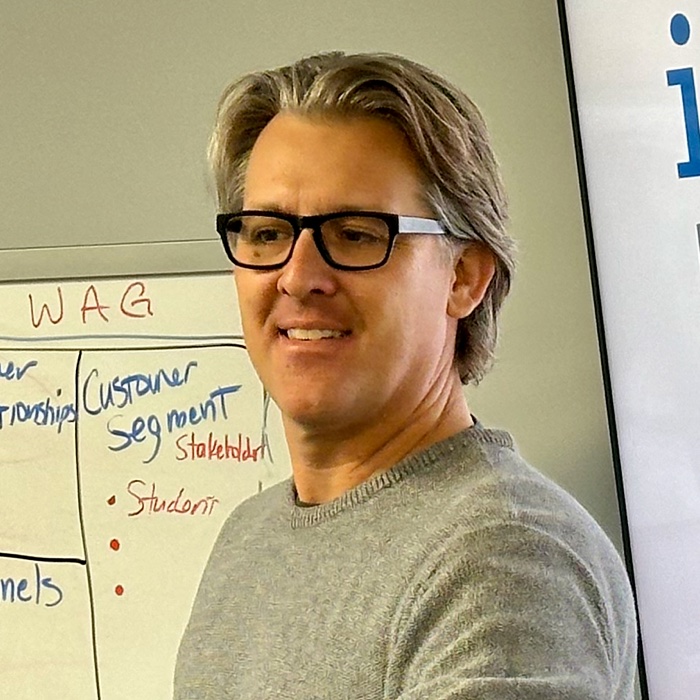
Founder of WILD×AI, and for over fifteen years a professor of innovation and entrepreneurship at four-year universities. He was a tenured, award-winning professor at Western Colorado University, where he built a student-led innovation, creativity, and entrepreneurship movement, and he directed the Center for Entrepreneurship and Innovation at the University of North Georgia from 2023 to 2025. He holds a J.D. from the University of Colorado School of Law and a Stanford Innovation and Entrepreneurship Certificate, and has trained more than 1,500 people in entrepreneurship and AI integration. He and his wife Andrea built and sold two businesses in rural Colorado: The Ruby of Crested Butte (sold 2019) and RubyResorts (sold 2024).

That is what the credentials say.

What the credentials don't say: he didn't speak until he was five. He was kicked out of college after three semesters. He later graduated with honors. He scored in the 50th percentile on his first LSAT and the 96th on his second. He failed the bar exam. Then he came back and crushed it. He has been through every gate the Class of 2030 is about to walk through. The WILD framework was built by someone who has walked every stretch of that journey.

And he has never stayed in one world.

A bed and breakfast in the mountains. A governor's office. A law practice. Companies built and sold. A university classroom. He was the change-maker in each of them, the off-the-beaten-path leader who left every place a little remade. He gave up a tenured chair, the security and the title and the benefits, because institutions cannot move at the speed this moment asks, and the work he is called to now could not be done from inside one. There is nothing wrong with that; we need institutions. But the breadth is the point. The framework comes from a life spent navigating new worlds from scratch, more than once, which is exactly what your kid is about to do.

Format

How the six weeks run

When

July 6 through August 14, 2026. Six weeks. Enrollment closes June 29.

Live sessions

Two 90-minute sessions a week, Tuesday and Thursday evenings, 6:00 to 7:30 PM Mountain (8:00 Eastern, 5:00 Pacific), Weeks 1 through 5, plus three to five hours of your kid's own work between them. Every session is recorded, so a missed evening is never a missed week.

The build session

One 90-minute 1:1 where Chris configures the Personal WILD×AI Navigator with your kid, on the values and history they have spent the weeks writing.

The cohort

Small by design, fully virtual. This is facilitated work, not a lecture, and every student gets real airtime.

Week 6 is a landing week

This week bends around move-in. As each student arrives on campus, Chris works with them 1:1 to load their real semester into the Navigator: their actual syllabi, professors, and course materials. The system has to meet the real classes, so this week flexes to each student's start date.

Chris stays in reach

The relationship does not end in August. Through fall semester and beyond, Chris is a real person your kid can reach for the questions that come up: course selection, a hard week, a decision that matters. Plus October and December cohort check-ins and a private cohort channel. The ongoing guidance is the work, not an add-on.

Pricing

Charter pricing, never repeated

Standard Tuition

$3,500

Begins with Cohort 2. Families enrolling now receive Charter pricing.

A sliding scale is available for families who need it. Ask Chris on the call.

What's included

  • All six weeks of live cohort sessions and curriculum
  • The WILD Compass, written and completed with facilitation
  • A configured Personal WILD×AI Navigator, built with your kid 1:1
  • The Build pillar: design thinking, a business model, a launched and published venture
  • Weekly office hours with Chris through fall semester
  • October and December check-ins and a private cohort channel
  • A completion credential recognizing what your kid built

Not included

  • A Claude subscription, about $20 a month; we point you to the right plan and any student discounts at onboarding
  • A laptop, plus a few optional tools we recommend, currently a voice-to-text app and a note-capture tool, most with free or student tiers

Who this is for

Who this is not for

Find Out Where You Stand

How AI-ready is your student?

Take the WILDiQ: College Edition. Ten minutes, free, no right answers. It reads how ready your student really is for the AI-saturated college years and emails a personal map you can bring to the conversation with Chris.

Get your AI Readiness Map
Questions Families Ask

The honest answers

Won't they just learn this in college?

No, and this is the part most people have backwards. The university is the slowest institution to teach the thing that threatens how it runs. That is the innovator's dilemma working exactly as written: faculty optimized for the old system are the last to build the new one, not despite their expertise but because of it. Your kid will live in the AI-native world either way. The only question is whether they walk in with a foundation or get shaped by whatever they bump into.

What is WILD Intelligence?

The human side of navigating uncertainty, the capacities AI cannot do for you: seeing clearly (Wisdom), choosing what matters (Intention), creating the conditions to move (Leadership), and learning as the ground shifts (Discovery). Chris and Andrea Greene have spent twenty-five years building it. It is the framework underneath everything in this program, and the thing that makes a person worth amplifying when the machine arrives.

And what is WILD×AI?

WILD×AI is where the human framework meets the machine: the practice, the tools, and the configured systems that keep a person sovereign while AI reshapes everyone around them. The College Edition is that work built for the college years. The broader version is what Chris builds for leaders and companies; we work with students because that is where the foundation is still being poured.

Is there anything in this for me, the parent?

Yes. Start with the free AI Readiness Map above, for an honest read on where your family stands. During the program you get weekly office hours with Chris for the questions that come up: course selection, faculty, campus life. And most parents find they learn the paradigm alongside their kid, because the conversations at home start to change. A dedicated Family edition is coming; ask to be told when.

Why only six weeks?

Six weeks of focused, twice-weekly work plus real practice is more than most college courses cover in a semester, and the compression matches the one window that matters: the summer before. Continuing access through fall semester is included precisely because the work gets tested then.

My kid moves into college in the middle of this.

So do most of them, and Week 6 is built for exactly that. It flexes around move-in: as your kid lands on campus, Chris works with them 1:1 to load their real semester into the Navigator, their actual syllabi, professors, and course materials. We hand your kid off the week they arrive, which is when the work starts mattering.

My kid's summer is already full.

Most weeks run five to six hours total, Week 5 a little more. The cadence is built to coexist with a job, training, or family travel. The live sessions are two evenings a week; the rest is your kid's own work on their own time.

What does my kid need, and what does it cost beyond tuition?

A laptop and a Claude subscription, currently about $20 a month for the plan that includes the agentic tool the Navigator is built on. We send a simple setup checklist before Week 1 and point you to student discounts where they exist. Everything your kid builds is theirs to keep.

Is my kid's information safe?

The Navigator runs on your kid's own account, on their own laptop. They decide what it knows and what it is allowed to do, and it is configured to refuse what crosses the boundaries they set. We do not hold their data. Before the cohort, every family gets our plain-language note on privacy and safeguarding.

Is the credential real?

It is signed by Chris and recognizes the specific work your kid completed: their Compass, their launched venture, their First 90 Days plan. It is evidence of real work, not a credential-mill sticker. Use it in scholarship essays, mentor conversations, or a resume. Or don't. The work itself is the point.

What's your refund policy?

Reserve your seat and we set up a short welcome call to make sure it is the right fit. If it isn't, full refund any time before the cohort begins. Once the work starts in Week 1, the cohort has committed to each other, so refunds close then.

What does "AI sovereignty" actually mean?

Using AI well, including the discipline of knowing when not to use it. The Navigator we build with your kid is configured to push them toward independence, not dependence: it refuses requests that violate the boundaries they set, and it is built to make them harder to flatten, not easier.

If You're the Student Reading This

This was probably sent to your parents. Read it anyway, because it only works if you actually want it.

You are about to walk into four years that decide a lot about who you become, holding a tool more powerful than anything your professors grew up with. Most people on your floor will use it to get answers and get caught less. You can be the one who actually knows how to drive it, with a system you built that knows you and that no one else has. This is yours to choose, not anyone's to choose for you.

There's a whole page written for you, in your words, not your parents'. Start there. Then the Student Reading tells you where you actually stand with AI right now - no grade, no right answers, and your answers stay yours. If it lands, tell your parents you want in.

The page written for you → Take the Student Reading

The Class of 2030 is about to walk into the most consequential identity-formation period of their lives. Most will arrive without a foundation. Yours doesn't have to.

July 6 - August 14, 2026 · Limited seats · Enrollment closes June 29

Two Ways In

Reserve a seat, or start with a call

Two ways in. If you are ready, reserve your seat below. If you would rather talk first, request a 30-minute call with Chris, you and your student together. Either way, the full details come to your inbox and you hear from Chris within 24 hours.

Reserve a place in the Charter Cohort now. After you reserve, we set up a short welcome call to make sure it is the right fit for your student, and you have a full refund any time before the cohort begins if it isn't.

Reserve my seat · $1,995

Charter pricing, never repeated.

Not ready to reserve? Tell us who you are and what you'd like next. The full details come to your inbox either way.

Something went wrong on our end. Email chris@wildnavigation.com directly and Chris will take it from there.

Charter pricing is locked for Cohort 1 families and never repeated; future cohorts run at standard tuition. The full details come to your inbox either way.

Got it. You'll hear from Chris within 24 hours.

A confirmation is on its way to your inbox now, and Chris follows up personally within 24 hours. Want to skip the wait? Book the 30-minute discovery call directly. In the meantime, the only prep is a conversation with your kid: do they want this? That answer shapes everything.